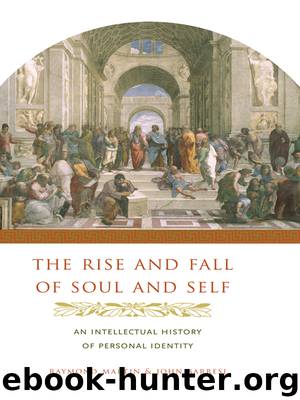
The Rise and Fall of Soul and Self by Raymond Martin
Author:Raymond Martin
Language: eng
Format: epub
Tags: Philosophy/General
Publisher: Columbia University Press
Published: 2011-12-10T05:00:00+00:00
Reactions to German Idealism
Hegel had many admirers, among them Marx, as well as many critics and detractors. Of these critics, Arthur Schopenhauer (1788–1860), Søren Kierkegaard (1813–1855), and Friedrich Nietzsche (1844–1900) are most worth mentioning. Whereas Hegel stressed the primacy of reason, objectivity, and rationality, Schopenhauer substituted will for reason, Kierkegaard subjectivity for objectivity, and Nietzsche irrationality for rationality.
In his most important work, The World as Will and Idea (1818), Schopenhauer accepted Kant’s distinction between the noumenal and phenomenal worlds and his claim that the existence and nature of the phenomenal world depends on its being experienced.27 But, in contrast to Kant, he claimed that through intuition the noumenal world can be known. Its nature is will, a nonrational, blind, ceaselessly desiring, meaningless striving after existence. He argued that this will is what each human being is essentially—one’s true nature. The phenomenal properties of humans—their intellects, preferences, and even their bodies—are objectifications of will. Since will is amoral, humans, at bottom, are horrible creatures. A key purpose of civilization is to break and tame them. Except for art, humans have few sources of pleasure. In sharp contrast to Hegel, Schopenhauer claimed that human history, far from being a progressive manifestation of spirit, is without purpose and essentially pointless.
Schopenhauer was among the first Western philosophers to have access to translations of Hindu and Buddhist scripture, by which he was profoundly affected. He claimed that while humans tend to see themselves as independent, self-sufficient beings, on the noumenal level there is neither unity nor plurality. The subject, which is the knower, rather than lying within the forms of space, time, and quantity, is presupposed by these very forms, which is why the subject is neither one nor many. When humans know something, it is this noumenal subject that knows, but this subject is never itself known.
Schopenhauer wrote a dialogue to express these ideas.28 Ostensibly devoted to the immortality of the soul, the real issue under discussion is not so much whether people survive their bodily deaths—that is, preserve their individuality—as what matters in human survival. Philalethes, who represents Schopenhauer, argues that personal identity, or, as he puts it, the preservation of individuality, does not matter—that is, that even from an egoist point of view, the preservation of individuality is not all that important. His antagonist, Thrasymachos, holds to the commonsensical view that the preservation of individuality is what matters primarily.
Philalethes assumes that people do not survive their bodily deaths as the individuals they were while alive. But, he argues, nothing of great value has been lost since a person’s individuality is not his or her “true and inmost being,” but only its “outward manifestation.” “Your real being,” he says, is eternal and unbounded. “So when death comes, on the one hand you are annihilated as an individual; on the other, you are and remain everything. Your life is in time, and the immortal part of you in eternity.”
Thrasymachos is not impressed by this view. So, to convince him, Philalethes asks him to consider
Download
This site does not store any files on its server. We only index and link to content provided by other sites. Please contact the content providers to delete copyright contents if any and email us, we'll remove relevant links or contents immediately.
| Anthropology | Archaeology |
| Philosophy | Politics & Government |
| Social Sciences | Sociology |
| Women's Studies |
The remains of the day by Kazuo Ishiguro(9000)
Tools of Titans by Timothy Ferriss(8396)
Giovanni's Room by James Baldwin(7346)
The Black Swan by Nassim Nicholas Taleb(7130)
Inner Engineering: A Yogi's Guide to Joy by Sadhguru(6796)
The Way of Zen by Alan W. Watts(6614)
The Power of Now: A Guide to Spiritual Enlightenment by Eckhart Tolle(5784)
Asking the Right Questions: A Guide to Critical Thinking by M. Neil Browne & Stuart M. Keeley(5775)
The Six Wives Of Henry VIII (WOMEN IN HISTORY) by Fraser Antonia(5515)
Astrophysics for People in a Hurry by Neil DeGrasse Tyson(5190)
Housekeeping by Marilynne Robinson(4449)
12 Rules for Life by Jordan B. Peterson(4305)
Ikigai by Héctor García & Francesc Miralles(4275)
Double Down (Diary of a Wimpy Kid Book 11) by Jeff Kinney(4273)
The Ethical Slut by Janet W. Hardy(4253)
Skin in the Game by Nassim Nicholas Taleb(4250)
The Art of Happiness by The Dalai Lama(4130)
Skin in the Game: Hidden Asymmetries in Daily Life by Nassim Nicholas Taleb(4007)
Walking by Henry David Thoreau(3962)
